Chris Miller looks into issues surrounding the nuclear weapons debate and whether we should talk about "disarmament" or "abolition."


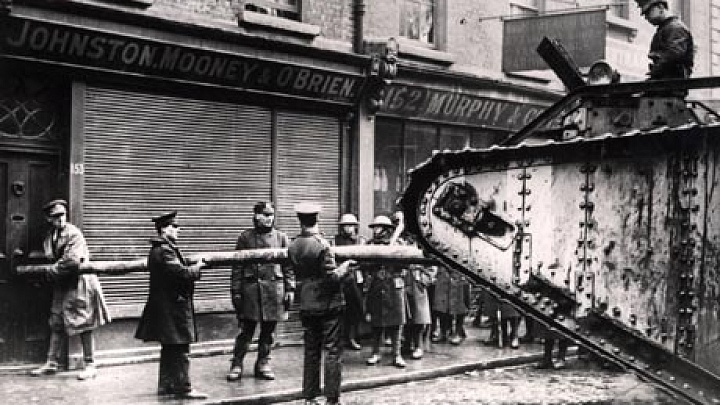
On Easter Monday 1916, roughly 1,600 armed rebels entered Dublin and declared an Irish Republic. No mass uprising occurred and no reinforcements arrived. Within a week, their rebellion was forcibly put down by the British. When thinking of the most-noted counterinsurgencies (hereafter referred to as COIN) of the past century, minds often drift to the dense jungles of Vietnam and Malaya, the vast deserts of Oman and Aden and the sprawling Oriental metropolises of Algiers and Hue. But one major period of conflict often overlooked: Ireland between 1916 and 1921.
In 1916, Ireland was overwhelmingly an active participant and supporter of the United Kingdom. By 1921, the island had been partitioned and all but the six Unionist-dominant counties of Ulster were an independent nation – the Irish Free State. In these five years, Britain fought two COIN operations: the Easter Rising and the Anglo-Irish War. For both, Britain’s military and political leadership largely acted in a strategic vacuum, failing to appreciate the realities on the ground in Ireland. Such mishandling stemmed from more pressing concerns elsewhere – namely the First World War raging in Europe – but also from a growing divide, initiated by a reckless British strategy, between the majority of the Irish people and the British state, which no side could rectify and which Republican insurgents actively widened. As we approach the centenary of the Easter Rising, the lessons from this example of COIN and the following five years of Anglo-Irish relations are an interesting and useful case study when considering operations in general, holding lessons which remain highly applicable a century later.
Black and Tan and Bloody
They were ‘a minority of a minority’ of dissident Republicans. Their ranks were largely composed of the minority of the Nationalist militia, the Irish Volunteers, who had not heeded the call to come to Belgium’s aid in 1914. Even within this minority, their leader, Eoin MacNeill, believed that rebellion would be suicide due to the lack of Republican sentiment. For the revolutionary Irish Republican Brotherhood’s military council, whose members had infiltrated the Volunteers, including Patrick Pearse, this did not matter; what was important was a “blood sacrifice.” Thus, the Rising was formed through a small minority of Volunteers under the control of the Brotherhood, as well as James Connolly’s Citizen Army.
COIN theorists tend to hold up the British as exemplar counterinsurgents because of their successful operation in Malaya, but we need to give Ireland in between 1916 and 1921 the attention it deserves.
Pearse’s sacrifice came in two parts: The initial defeat of the Rising and then the resulting coercion; Pearse would not have been disappointed. The British government immediately declared martial law in Ireland under General Maxwell. Through this, in dribs and drabs, the leaders of the Rising – including Pearse – were taken from their cells in Kilmainham Gaol and executed; in total, 16 martyrs were made. On top of this, in the weeks following the Rising, 3,430 men and 79 women with vague Republican links were arrested, with most of these being court martialled or interned in Britain. Whilst the rebels had initially been harassed and spat on by Dubliners, viewed as traitors, as the spring of 1916 progressed, “on every level, martyrolatry had taken over.”
In subsequent months, Republican sentiment grew from where there had been none. As World War One continued, however, no major military action was taken until after the 1918 general election in which Republican candidates under the Sinn Fein banner claimed 73 seats in comparison to the moderate – and previously hegemonic – Irish Parliamentary Party’s (IPP) six. Under this political mandate, taking up seats in their own Dáil Éireann (refusing to sit in Parliament), the Irish Republican Army (IRA) began an escalating campaign of violence and intimidation against crown forces in Ireland. Of the (roughly) 1,400 deaths in the Anglo-Irish War, 18 were in 1919, fewer than 300 in 1920, with the rest occurring up until the truce in July 1921. The IRA, however, never had more than 5,000 active Volunteers, relying on flying columns to inflict swift damage on a much better armed and numerous enemy.
The response to the IRA insurgency from Britain was somewhat confusing. Initially not recognising the military threat of the IRA, Lloyd George declared that a civil response was required to defeat this ‘murder gang’. With the low morale of the Royal Irish Constabulary (RIC), however, by mid-1920, the British establishment in Dublin Castle recruited British ex-soldiers to have an auxiliary role in the RIC. These were to become known as the infamous Black and Tans and the less well known (yet probably more infamous) Auxies. Both were notorious for their unwarranted violence, ill-discipline and drunkenness; indeed, even the Auxies’ commander, F. P. Crozier, resigned rather than lead what he viewed as a drunken and insubordinate rabble. Coming from a military background and having only the most rudimentary police training, these men were poorly suited for the intended civil response Lloyd George’s government had envisioned.
Sun Tzu Revisited
Unsurprisingly, Britain was forced to negotiate with the ‘murder gang’, leading to the Anglo-Irish Treaty of 1921 after months of negotiation. Under this agreement, the six Unionist-dominated counties of Ulster remained in the United Kingdom, whilst the rest of Ireland became independent, albeit remaining within the Empire and with the British monarchy as head of state. From this relative strategic failure for Britain, however, comes a number of notable lessons, a few of which shall be explored presently.
Britain held a grand strategic aim of controlling Ireland. The government’s inability to formulate a coherent operational strategy, however, led to relying on blunt military tactics which ensured that Britain never truly held the initiative, constantly distracted by managing the political damage done through these tactics. COIN theorists tend to hold up the British as exemplar counterinsurgents because of their successful operation in Malaya. Hopefully future academic articles in COIN and strategic studies more broadly will give Ireland in between 1916 and 1921 the attention it deserves, with this short article highlighting just three of the numerous strategic COIN lessons which may be taken away.


Chris Miller looks into issues surrounding the nuclear weapons debate and whether we should talk about "disarmament" or "abolition."
Air Force Captain Brad DeWees looks at Niccolò Machiavelli's "The Prince" and explores what lessons we can take from it for military innovation.
Felix Imonti argues that IS's main concern should be how they are to economically prop-up their Caliphate, instead of the bombs being dropped on them.


Arnold Isaacs reviews #VietThanhNguyen's book on how the #VietnamWar and its spillover conflicts are remembered ciceromagazine.com/r…


