Bridget Coggins on her new book, Power Politics and State Formation in the Twentieth Century, on how states come to be in the modern world.



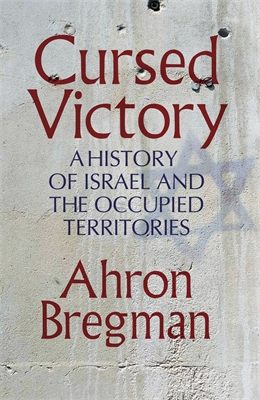 Cursed Victory: A History of Israel and the Occupied Territories
by Ahron Bregman
Penguin, 416 pages, $25
Cursed Victory tells the story of Israel’s troubled presence in the West Bank, Gaza Strip, the Golan Heights and the Sinai Peninsula since its sweeping victory in the 1967 Six Day War. Drawing on countless high-level interviews, never-before-seen letters and top secret memos, distinguished Israeli historian Ahron Bregman traces the evolution of the military occupation over four decades. The book provides vivid portraits of the key players in this unfolding drama, including Moshe Dayan, Bill Clinton and Yasser Arafat, yet always reminds the reader how diplomatic negotiations in Madrid, New York and Oslo impacted the daily lives of millions of Arabs.
First, you mention the mass displacement of Palestinians and other Arabs as one of the central or root causes of the current conflict raging today. So was this preordained by actions/choices by Israeli leaders made decades back?
The Israelis have always sought to have the lands they occupied – both in 1948 and in 1967 - without its Arab populations. Empty lands are easy to settle. In Cursed Victory, I quote the Israeli Prime Minister Levi Eshkol who, at the end of the 1967 war, said: “We got a dowry [by which Eshkol meant new lands]. The problem is that with the dowry came a bride [Arab populations], and we don’t want to have this bride.” Israeli leaders never actually gave direct orders to the military to deport Arab populations from occupied lands, as they knew that ethnic cleansing is not allowed according to International Law. But there was no need in orders, as the army understood that it’s better to get rid of the populations. So you had a mass exodus of Arab populations in 1948 and also in 1967. The wish of the Palestinians to return to their homes and lands, what they often refer to as their “Right of Return” and which the Israelis call “Claims of Return” is the most complicated problem to be sorted out in peace negotiations between Israelis and Palestinians. It is much more complicated than solving the Israeli-Palestinian dispute over the future of Jerusalem, the city both sides claim as their capital.
You relied on access to classified documents. Can you describe what these docs were and how they uphold the main thesis of your book?
Cursed Victory contains loads of new never-before-published documents. Some of the documents are top secret. For example, I quote from transcripts of telephone conversations between President Bill Clinton and world leaders, secretly recorded by Israeli agents. I also quote from transcripts of telephone conversations between Arab negotiators during their peace talks with the Israelis – again, all secretly recorded by the Israelis. Of course, listening to what Arab negotiators say to each other, gave the Israelis a huge advantage in the actual negotiations as they could adapt their views accordingly. From these secretly recorded telephone conversations we can learn, for instance, that Syrian officials negotiating with the Israelis wished to conclude a peace deal with Israel and were willing to compromise at a time when the Israelis preferred to cling to the occupied lands and not return it.
How has America’s relationship with Israel informed the latter’s foreign policy in the region?
One of the documents I expose in Cursed Victory is a secret letter sent by American Secretary of State Madeleine Albright to Israeli Prime Minister Benjamin Netanyahu in which she promised not to put forward any peace proposals that Israel “would consider unsatisfactory” and she continued that the US will conduct “a thorough consultation process with Israel in advance…”. In other words, the US promised the Israelis to show them any peace proposals before presenting it to the Arab side. This pledge is effectively carte blanche to Israel to veto any American peace program they don’t like and it shows that the Americans are not always acting as impartial mediators in peace negotiations.
Similarly, how important is the diaspora, whether in England, France, or America, to the calculus of Israel in its decision to wage war or not?
I’ll quote to you something from Cursed Victory which summarizes my thoughts about the role of the Jewish diaspora in peace and war: “I believe that the verdict of history will regarded the four decades of occupation described in this book as a black mark in Israeli and, indeed, Jewish history. This was a period in which Israel, helped by the Jewish diaspora, particularly in America, proved that even nations which have suffered unspeakable tragedies of their own can act in similarly cruel ways when in power themselves”.
You describe pretty harsh conditions of Israeli occupation of Gaza and the West Bank, comparing it to 19th century colonies. Some might call that a stretch, no?
The Israeli occupation is as brutal as many other occupations. Watch the film The Battle of Algiers and imagine that the method used there, by the French against the FLN, are similar to the methods used by the Israelis against the Palestinians; the latter includes physical torture. In Cursed Victory, I quote the Defense Minister Moshe Dayan who, in 1967, observed that if he had to choose to be occupied by any force from among the nations of the world, he doubted he would chose Israel. He was right; looking back it is clear that Israel was – and remains – a heavy handed and brutal occupier.
How do you see the current impasse in Gaza resolving itself? And what lessons can we draw from the historical documents you reveal in your book?
If the Palestinians wish to have their independent state, they must resist the Israeli occupation. They can’t get their state on a silver platter, nor can they get it by going to cocktail parties or to the UN. The Israelis lost one per cent of their population in their war of Independence in 1948 and they don’t stop talking about it – and for good reasons. So resistance to occupation is something which the Palestinians must do and I have always encouraged them to do so, though I think that their resistance should be non-violent. If they resort to bombs, rockets and missiles, if they send suicide bombers to Israeli towns and cities, then the Israelis – who are much stronger – will crush them. The documents I use in my book strengthen the view that the Israelis only move when under pressure, otherwise, they don’t bother much. I was once asked what does “a non-violent resistance to occupation” mean? My answer was that the Palestinians should, for instance, use social media to encourage as many Palestinians as possible to get out to the streets, wrap themselves in white sheets, and throw flowers at the soldiers.
Was it hard writing the book as an academic, given your own previous life as an Israeli soldier and your connection to the issue you write about?
I’ve spent the last 25 years in the UK and now I’m a British citizen. But I still regard myself as an Israeli and I miss Israel very much – its people, the foods, the language, the informality. But I hate the Israeli occupation – deeply so. It is cruel and inhumane and it must end – the sooner the better. I hope that Cursed Victory will help to expose the cruel face of the Israeli occupation and help – even if a little bit – to end it, not only for the sake of the Palestinians, but also for the sake of Israel.
 Ahron Bregman is the author of four books about Israel and the Arabs: ‘The Fifty Years War’ (with Jihan el Tahri); ‘Israel’s Wars’, A History of Israel’ and ‘Elusive Peace’. He teaches at the Department of War Studies, King’s College London.


Bridget Coggins on her new book, Power Politics and State Formation in the Twentieth Century, on how states come to be in the modern world.
Nicolaus Mills on his book, Every Army Man is With You, and the story of the 1964 Army football team that defeated Navy, but went on to fight less certain and...
Jeff Bridoux, co-author of a new book on Democracy Promotion, discusses this controversial concept in the post-9/11 era following George W. Bush's 'Freedom...


One Comment