
In her new book, Soldier Girls, journalist Helen Thorpe traces the careers of three women who decide to enlist in the National Guard and how their deployments in Iraq and Afghanistan affected their personal and professional lives.
 Your book challenges a lot of the conventional wisdom of the type of woman who enlists in the U.S. military. We tend to assume they are deeply patriotic, perhaps right of center or religious. or we typecast them as heroic GI Janes or like Jessica Lynch, or as morally repugnant, like Lynndie England. Was part of your goal in writing Soldier Girls to debunk these tropes?
I found the three women who are featured in Soldier Girls to be compelling because they surprised me. I’m not sure I had a conscious goal of debunking stereotypes, but I do think I chose to focus on them because they represented a diverse cross-section of women in terms of age and political beliefs, and because I hadn’t seen portrayals of female veterans like them.
At times the men in the three women’s units appear downright hostile to them. Has the male-dominated culture and ethos of the military, in your opinion, changed much? What other challenges do women deployed face?
I was struck by the fact that the women were treated very differently depending on which unit they had been assigned to. Desma received the worst treatment of all, in one unit that had previously been all-male. She was placed in that unit, which was part of an infantry regiment, because it was doing support work. That made it possible for women to join the unit temporarily. The men in that regiment did not want to serve alongside women and Desma said she had never felt so much like a second-class citizen. Yet at other times and her military career she had no difficulty getting along with men. Her experience seemed to depend a lot on the history of the unit in terms of experience with women and the leadership of that particular group.
I was interested in writing about National Guard soldiers because they had enlisted with the idea of serving only one weekend a month and two weeks in the summer, and the nature of the commitment they were asked to fulfill changed dramatically after 9/11.
You describe a boozy dating scene on bases - the characters have affairs on their then-boyfriends. This depiction has drawn some online criticism from female vets who say this is not indicative of their deployments. Are these criticisms fair?
I tried to make clear in the book that the decision by two of the women I wrote about to have relationships while overseas was considered problematic by some of their colleagues. Within the tent that Desma and Michelle shared, there was great division on the subject of whether the affairs were understandable or should be condemned.
I did not know about the affairs at the outset of my research. In the end, I chose to include the material because both Desma and Michelle said that one of the central consequences of the choices they made was that they lived through a decade of broken relationships. Each time they went on a deployment, they started a new relationship. And each time they returned home, they tried to hold on to the deployment relationship, only to have it fall apart once they were back in the United States. This is one version of what happens when people are asked to go on lengthy multiple deployments.
Talk a bit about sexual violence in the military. One of your female leads is forced to sleep with a knife for fear of being raped. Has writing the book changed your view about the recent charges of sexual harassment, rape, and violence in the armed forces? Do you think enough is being done by the military brass to combat sexual violence?
I think the book explains the highly charged atmosphere between men and women on military posts in which sexual violence is likely to take place. As long as assaults and rapes continue to occur at such high levels on military bases, not enough is being done.
One of your central characters, Desma, is a single mother of three, and yet she still enlists. Are most moms who enlist motivated by some larger purpose, by the dismal job market, or some combination thereof?
Desma was married with one child when she began basic training. She went on to have two children during the course of that marriage, then got divorced. She never anticipated being sent overseas, as she was only a member of the National Guard. However, when her deployment orders came, she complied with them, as she was legally obliged to do. At that point, as luck would have it, she was a single mother with three children – and she had to find other places for her children to live while she was gone. Her experience was not unique. Within the same battalion, there were other single parents who had to do the same, including her best friend Stacy Glory. Stacy had also previously been married, and divorced after she had joined the National Guard. I don’t think either of them would have volunteered to go to war while a single mother. Rather, the order to go to war happened to come after their marriages had ended and at a point in time when the National Guard was being used in an unusual fashion.
I’m curious, why did you choose to focus on the National Guard? One criticism I heard of your book from a female veteran I know is that those who enlist in the reserve are somehow different than who enlist in the armed forces. Is that a fair criticism?
It doesn’t seem like a criticism to me. The veteran is correct, enlisting in the reserves is completely different than enlisting to become a full-time soldier, sailor, airman or Marine. I was interested in writing about National Guard soldiers because they had enlisted with the idea of serving only one weekend a month and two weeks in the summer, and the nature of the commitment they were asked to fulfill changed dramatically after 9/11.
Talk to me a bit about your reporting process as a journalist. What was it like tracing these women’s lives for something like twelve years? These women enlisted thinking they’d never see armed combat. If there was no 9/11, I imagine your book would be less of a page-turner since you’d be following them in Indiana, not Iraq or Afghanistan.
I met the women in 2010, after they had safely returned from both of their deployments. We did four years of interviews and they shared a large number of documents with me, including emails, letters, medical records, therapy notes, military documents, and diaries. Because they were willing to share so much, we were successful in our goal of re-creating the previous decade in vivid detail. I loved getting the chance to allow each of the women to speak by relying upon letters they had written home or diaries they had kept while overseas. Hearing them speak in their own voices really brought them to life.
One thing about women in combat, according to Geoff Dyer’s new book, is that the latrines on an aircraft carrier are kept much cleaner. How else has the military changed with women on the frontlines?
There have been hundreds of changes, large and small. The military has had to learn how to provide medical care to women, such as obstetrics and gynecology. They have had to stock tampons and menstrual pads in the PX. They have had to grapple with what happens when men and women form relationships while deployed overseas, when that is often against the rules. The military has had to figure out how to create equal opportunities for women, when they sometimes report to men who feel they do not belong in the military. Military leaders have also had to learn how to deal with charges of harassment, abuse, assault and rape, in a military legal system that does not always assign judgment to people who have expertise in those types of criminal complaints. Obviously they are still learning how to handle these things in an effective fashion.
I’ll never forget a history professor of mine, while studying abroad in the mid-90s and walking through Verdun, tell me that women were unfit to serve in combat. I was still only a teenager so I assumed he was correct. Do you think we’ll ever see women serve in special operations units or infantry?
I assume we are headed in that direction.
[Photo, courtesy of Georgia National Guard via Flickr Commons, is of enlistment of first female member of Georgia’s National Guard over 40 years ago.]
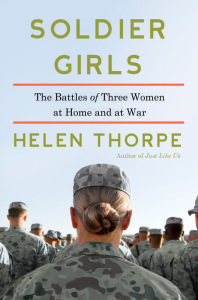
Soldier Girls: The Battles of Three Women at Home and at War
by Helen Thorpe
Scribner, 416 pages, $17.71

Helen Thorpe is a nonfiction author in Denver, Colorado. She has been a journalist for over 20 years and has written for The New York Times Magazine, The New Yorker, Texas Monthly, and 5280. Her first book, Just Like Us (Scribner), won the Colorado Book Award, was named one of the best books of the year by the Washington Post, and was adapted for the stage by the Denver Center for the Performing Arts in a October 2013 play.


I’m sorry but women do not belong in combat units. Over thousands of years thousands of cultures have experimented with the idea and all decided against it. Today the West is going back to this idiocy merely to appease the feminists.
God save us if we ever get into a real war again.