Bridget Coggins on her new book, Power Politics and State Formation in the Twentieth Century, on how states come to be in the modern world.


For decades, Menachem Klein has immersed himself in Israeli-Palestinian relatioins, as both an advisor of the Israeli government and a scholar. His “leftist” views have cost him career advancement at times, but he has continuted to push for peace. Klein has written several books about his experiences and research. His latest, Lives in Common, chronicles the lives of Arabs and Jews in Jerusalem, Jaffa, and Hebron.
 You have this great line about the 1948 war: Even during the war the hope of restoring common life prevailed. When, in 1948, the fighting compelled many Palestinians in Jerusalem’s Talbiyyeh neighbourhood to leave their homes and Jews filled the properties left vacant by their departure, Reuven Mass, the Jewish head of the neighbourhood, carefully recorded every such incident. Mass presented each new Jewish occupant with a “housing receipt certificate,” upon which he recorded precise details relating to the property. This was a man whose son had been killed by Arabs three months earlier! It’s hard to imagine that happening in today’s climate. Would you agree?
Sure, I fully agree. The main difference between then and now is that then, Mass’s keeping his eyes on Palestinian property was motivated by his living in common with Palestinians as equal natives. Unfortunately this is not the case today. Too many Israelis see their rights as overriding those of the Palestinians.
Describe your goal in writing this book. Who is your target audience? And why write this book now?
It took me about six years of research and writing. In this book I move from dealing with institutions and political parties, on which I wrote in my previous books on Jerusalem, to peace negotiations and the Israeli-Palestinian conflict since 2000, to deal with everyday life encounter of the average citizen in their joint public spaces. My target audience is the general reader. I wrote a narrative covering 150 years. It’s not a typical social science study on a few years aimed for experts only.
That’s not a bad thing. Yet, in your book you discuss the 2002 Arab League peace proposal as outlined by Saudi Arabia and other members, and its promise for peace but also Israeli integration into the region and full diplomatic recognition. Is that blueprint really still achievable? How might the stars align for such a solution to occur in your view?
It is achievable if Israel chooses peace. The Arab peace plan was proposed in 2002, but the Israeli cabinet never discussed it or accepted it, not even as a basis for future negotiations. Once agreed and implemented, it does not mean turning Israel into an Arab state, but rather to maintain more or less normal relations with its neighbors. It has to start with good relations between institutions, later followed by normal relations between citizens. It is indeed a long process, depending first and foremost on the Israeli decision to prefer normalization and states living in common over being a garrison state with closed borders [and people] frightened by its hostile neighbors.
You describe “the other” in your book, whereby both sides shared space and cohabited in the past, but that this is missing today and so both sides demonize “the other.” The result is when you had the killing of the Yeshiva students, it set off a chain of events that led to revenge killings and eventually war. How do you get both sides to see “the other” through a different lens? Is it a case of more cultural exchanges and integration? I have a cookbook on my shelf that promotes the use of food and culinary methods to bridge the divide between Palestinians and Jews.
Sure, it’s difficult to abolish the psychological wall created by fear, bloodshed, and demons. But it is necessary. Only when I see that the other side, my enemy, is a human being with the same fears, demons, and rights that I have we come close to peace. Only if I acknowledge that acts my side made helped the other side perceive me as a demon – then we are on the peace track. This is not an easy experience and it should be done by both sides. It happened in South Africa. The substance of this process is to humanize the other. That is what I try to do in my book, by exploring our common living and the tragic process that brought us, Israelis and Palestinians, to where we are today.
You also write: “Writing in the 1970s Ya’akov Yehoshua, the father of the famous Israeli novelist A. B. Yehoshua, described how, throughout his childhood in the Old City of Jerusalem in the early twentieth century, “the residential courtyards of the Jews and Muslims were common. We were like one family.” “When other children in the neighborhood hurt us, our Muslim friends who lived in our courtyard came to defend us” wrote Aryeh Sasson, a Jew living in the area’s Muslim quarter at a similar time.” Was it really that idyllic in the past? Just want to push back since we heard a lot of this kind of nostalgiac coverage of the past during the war over the summer.
Yehoshua’s tone is indeed nostalgic, but through his and others’ memoirs we can read how it was then. I don’t think we are able to spin the history wheel backwards. But at the same time it is a big mistake to impose our present animosity and conflict on the past and read history according to today’s headlines. Moreover, in my narrative on the late 19th-early 20th centuries, I include memoirs on clashes between Jews and Arabs. My narrative is far from coloring those years just in one color. I wish to help the reader seeing the past as different from the present, and therefore conclude that the future may be different from the present. Both sides can learn from their past experience how to build a better future. The way to make it is by seeing the other not as an abstract entity but as a human being like me. Once we had it – and we can regain it. I show it in the chapter on refugee after [the] 1967 [war], visiting the homes they lost in 1948. Not in all cases did it happen, but there were more than a few cases in which human encounters [trumped] demonization, war trauma, and fear.
The latest round of settlement building seems almost intended to derail any hope for future talks, or at least appears to be thumbing its nose at the international community. Are these settlements making an agreement less achievable, or are we in the West just overblowing their importance, and they are a side issue?
Settlements expansion have become a big problem, and, indeed, agreement today is more problematic [because of them]. With this expansion, the cost for Israel to withdraw is higher because the state, its agencies, private companies, and citizens are much more invested in the project of settling and controlling the Palestinians. If one wants to check if he or she overblows the settlements – I suggest him or her to make a list of who invests in this project, how long, and how much is put into the project. It will not be easy to reverse this process, which has lasted almost 50 years. We have three generations of settlers. For many, it is their place, their home. For me it’s clear that when Israel chooses peace and withdraws, Jewish radicals will use arms against this decision. It happened in Algiers, and we remember why and by whom [former Israeli Prime Minister Yitzhak] Rabin was assassinated. Rabin, it should be noted, did not evacuate a single settlement nor recognized Palestinian sovereignty nor divided Jerusalem. He just signed an interim agreement and recognized the PLO as the legitimate representative of the Palestinian people.
Sweden and the British parliament, at least symbolically, appear to be recognizing the Palestinian state. How is that being viewed in Israel, both by the public and by the hardline government. I also wonder what effect this kind of de facto recognition by more members of the West have on the, at least at the moment, moribund peace process?
The [Israeli] government speaks in two voices. On the one hand, it tries to underestimate those recognitions by saying that they have no practical outcomes. On the other hand, the government signals its fear that this is just the start of a snowball leading to political pressures and later to sanctions. And the government is made up of hardliners. The public in general accepts this schizophrenic approach. Western public opinion is moving gradually against Israeli de facto annexation and the Israeli occupation because it has lasted too long, with no expiration date, and without a trustworthy political process that will lead to an expiration date. Western public opinion of the 21st century is unwilling to support Israeli policy that resembles for the West its past colonialism or apartheid. Western public opinion sees Israel as part of the West and its value system, so therefore it opposes Israeli policies.
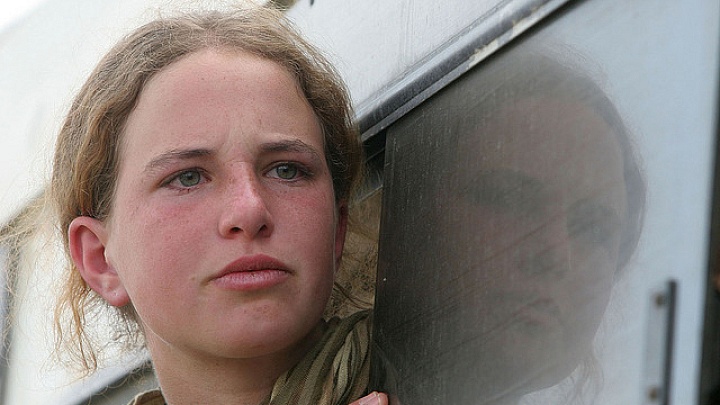
[Photo: A Jewish settler youth who was evacuated from as she is taken away on a bus following the evacuation of the Jewish settlement of Homesh, in the northern West Bank. PHOTO BY Lior Mizrahi, via Flickr Commons]
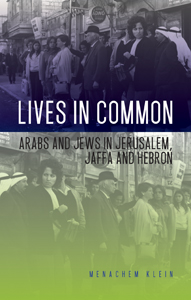
Lives in Common: Arabs and Jews in Jerusalem, Jaffa and Hebron
by Menachem Klein
Hurst Publishers, 240 pages, $20
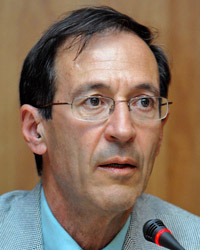
Menachem Klein teaches in the Department of Political Science, Bar-Ilan University, Israel, and was a team member of the Geneva Initiative Negotiations in 2003. He has advised both the Israeli government and the Israeli delegation for peace talks with the PLO (2000), was a fellow at Oxford University and a visiting professor at MIT. He is the author of The Shift: Israel-Palestine from Border Struggle to Ethnic Conflict (Hurst).


Bridget Coggins on her new book, Power Politics and State Formation in the Twentieth Century, on how states come to be in the modern world.
Nicolaus Mills on his book, Every Army Man is With You, and the story of the 1964 Army football team that defeated Navy, but went on to fight less certain and...
Jeff Bridoux, co-author of a new book on Democracy Promotion, discusses this controversial concept in the post-9/11 era following George W. Bush's 'Freedom...


