
America’s highest official intelligence representative in Germany left the country yesterday following a request by the German federal government, a symbolic act of protest following revelations that U.S. intelligence was receiving information from an employee of Germany’s foreign intelligence service, the Bundesnachrichtendienst (BND). Upon arrest, it was first believed the man had been working with Russian intelligence, but soon emerged he was a paid CIA asset. U.S. intelligence was apparently specifically interested in the German government’s reaction to recent revelations regarding the NSA’s mass signals intelligence collection operations and especially the interception of Chancellor Angela Merkel’s private phone calls. One does not need a ‘mole’ inside an intelligence service to understand that the mood in Berlin has turned starkly against American spying. Germany had already been considering how best to counter U.S. espionage and this latest scandal has added fuel to the fire.
So how does one counter electronic espionage? In today’s digital world, it is hard to imagine living life without broadcasting large amounts of capturable electronic communications information. From the moment people get up in the morning until they go to bed at night, they leave behind them a trail of data. You get up in the morning and connect to the internet. You read news headlines from major media outlets. You check your email, Twitter, Facebook or other social media sites while you drink your morning coffee. Then you get to work and log in to your system, send emails, and access electronic databases. At some point—or all day for some—you get on the telephone. The proliferation of Smartphones means that many people spend every waking moment sending out signals intelligence information. Even when asleep, the signals from electronic devices continue.
It was not always like this. I recall about 20 years ago my father called me over to our 486 megabyte desktop computer to show me this thing called ‘the internet’. He had connected to a ‘server’ at the nearby university over the telephone using a ‘modem’, a grey plastic thing with blinking lights about the size of a large dictionary. When I asked him what it did, he replied that it would allow him to type messages to other people on the network over the computer. I was wholly unimpressed. Why would you communicate with somebody on a computer over a phone line when you can just call them? It seemed rather silly to me at the time.
Could the answer for those concerned about electronic espionage and surveillance be to go back to the “stone age”? It appears that Germany and Russia are considering that very option.
This is to say that there was a time not long ago when everyone lived life and ran businesses and governments without broadcasting vast amounts of electronic data for other people—not just intelligence agencies—to capture. Though it is the way the world works now, it did not always and it does not have to be. But could the answer for those concerned about electronic espionage and surveillance be to go back to the ‘stone age’? It appears that Germany and Russia are considering that very option.
Patrick Sensburg, a member of Chancellor Merkel’s Christian Democratic Union (CDU) party and head of the parliamentary investigation into NSA spying in Germany, says he and his colleagues are seriously considering reverting to fully non-electronic means for producing and distributing their reports. No more emails. No more Word documents or PDF files. They would go back to using typewriters and paper files. However, other members of the German parliament have called the idea ridiculous and it cannot be that the government and security services are utterly defeated as to how to digitally counter foreign electronic surveillance. Ridiculous or not, Sensburg’s committee is taking the issue of electronic intelligence serious enough that before every committee meeting all the members seal their cell phones in a metal box in which loud classical music is being played.
This all may not be as ridiculous as it sounds and these concerns are real. President Obama and his staff are known to use a ‘spy tent’—a tent with opaque sides and speakers broadcasting noise interference outside in an effort to counter audio and video surveillance devices. The tent is erected inside hotel rooms or homes at any overseas location the President and his security staff spend the night in and they only discuss classified matters inside it in an effort to defeat electronic eavesdropping. Other less-senior U.S. officials dealing with classified exchanges overseas end up using a structure akin to a metal coffin. At home in the U.S., the private homes of cabinet secretaries and national security officials are frequently swept for eavesdropping devices and a room in the house is outfitted for secure conversations and computer use. Even America with its major investments in security uses physical security means to defeat electronic eavesdropping.
Germany is not the only country contemplating going back to the typewriter to counter U.S. electronic surveillance. Following revelations of the scale of the NSA’s signals intelligence gathering operation by Edward Snowden, Russia’s Federal Guard Service (FSO)—akin to Britain’s MI5—reportedly acquired a number of fully manual typewriters. Besides the fact they contain no electronic components, the benefit of using such typewriters is that each has an individual ‘signature’ to how it types, allowing any document produced from them to be traced back to an individual typewriter. In this case it is done purposely, but during the Cold War, and in movies and spy novels, tracing back documents to a single typewriter and anyone with access to it was a valuable counterintelligence tool.
But this latest episode of U.S. spying in Germany shows that papers can be stolen just as easily as electronic documents. America’s man inside the BND handed over paper copies of documents to his handler. Paper documents did not stop Cold War spies from spiriting out documents to their contacts. Oleg Penkovsky, probably America and Britain’s most highly-placed agent inside the Soviet Union, over the course of 17 months provided CIA and MI6 with piles of documents relating to Soviet military capabilities, including the top secret operating manual for the nuclear-tipped SS-4 intermediate range ballistic missile. Of course, Penkovsky was also discovered by the KGB and tried and executed as a spy.
Nonetheless, this episode shows that using paper to store secrets still means a human being must type them, must file them, store them, draw them out, copy them, deliver them to a handler, and then return the files—all without being caught. Though many spies were able to keep this up for years or even decades, they were eventually caught. This paper shuffling creates a trail. Record keeping of who did what where, when, and with whom is the heart of any counterintelligence program. The use of computers and phones also creates a trail for investigators to follow, but in the case of electronic espionage the perpetrator may be sitting safely behind a desk on the other side of the world, as recent episodes of Chinese military computer hacking show.
Going back to staples, paper clips, filing cabinets, and secretaries banging away on typewriters may not be as crazy as it sounds.
This would require more of a focus on human intelligence by intelligence agencies who wish to gather such information, something the U.S. has been less successful at than its opponents since WWII. The U.S. and its allies have historically had much more success with signals and electronic intelligence gathered from computers and telephones. Over the last 20 years, U.S. intelligence has become very focussed and dependent upon electronic intelligence. In the run up to the 2003 Iraq War, the U.S. had virtually no HUMINT sources of its own in Baghdad—though some would argue they would have been ignored any way. Electronic intelligence collection capabilities are often much more expensive to develop, but—up to now—have left behind a smaller footprint than the public uncovering of ‘moles’ or spies. Target states converting to paper would mean that human spies would have to come to a certain location to obtain physical files. It would mean the U.S. and others would have to focus more on human intelligence. This creates many more opportunities for the intrigue to be discovered by counterintelligence.
Edward Snowden was able to acquire at least 58,000 classified documents, though only very few of them have been leaked as yet, and by some accounts it may be many more. It appears—so far—he was working alone. It does not seem likely that Kim Philby, Klaus Fuchs, Oleg Penkovsky and other famous Cold War-era spies, some of whom spied for decades, were able to provide 58,000 documents to their handlers, despite being supported by foreign intelligence agencies and spy networks. It would have been much harder for Snowden to smuggle out 58,000 paper documents. When entire libraries of electronic information can be uploaded to small external devices, switching the same amount of information to paper makes it a virtual physical impossibility for anyone to carry it away overnight and disappear.
However, the U.S. Department of Veterans Affairs provides a cautionary tale in the other direction. Though the digital age began almost 20 years ago, the VA continues to use paper files when it comes to veterans’ compensation claims and is notorious for losing or misfiling paperwork. It is a true story that the VA once had to shut down a facility because the sheer weight of the huge number of paper files stored there had made the entire building structurally unsound. Any paper-based system would have to be competently administered or its users would suffer the same fate of the thousands of U.S. veterans who are still waiting in line for their claims to be processed. This would remind many Germans of the famous tale of the Hauptmann von Köpenick—the Captain of Köpenick—a man who put on a military uniform, gathered together some veterans, and instigated a military coup against the city government because its paper-shufflers delays were keeping him from getting a job.
Though some dismiss it as ridiculous, converting the storage and transmission of security information from electronic to paper would have advantages. WWI and WWII—and pretty much every war before them—were won using paper files. They worked before. It does have counterintelligence value and today that is what governments in places such as Berlin and Moscow are after. It would mean U.S. intelligence would have to invest more time and money into human intelligence to gather such information. But it would mean a lot more government paper-shuffling, something there is still far too much of even in the digital era. Nonetheless, going back to staples, paper clips, filing cabinets, and secretaries banging away on typewriters may not be as crazy as it sounds.
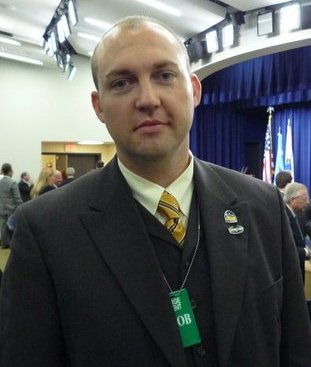 Chris Miller is a U.S. Army veteran and Purple Heart recipient following two tours in Baghdad, Iraq and has worked as a military contractor in the Middle East. His work currently focuses on strategic studies. His interests are CBRN, military and veterans issues, the Cold War, and international security affairs.
Photos: Flickr Commons by 1) Dorin Popa 2) Campact 3) Dan


