

"Laws are silent in times of war."
Latest:   

Time to Retire GWOT Mindset in Africa

August 6, 2014 at 5:00 pm  •  1 Comment

By

The stated goal of this week’s U.S.-Africa Leaders Summit is the “fostering [of] stronger ties between the United States and Africa.” This is a good news summit—Boko Haram, Ebola, and homophobia for the moment sidelined. Why all the “Africa Rising” feel-good rhetoric? “In short,” as the New York Times put it, “there is money to be made there.”

Business in Africa is indeed booming, and competition for markets and resources is intense. Yet the security sector is where U.S.-Africa ties have most clearly deepened over recent years. Even so, the conference agenda devotes only 90 minutes on day three—just after photo ops—to “Peace and Regional Stability.” Might too much attention to security issues and big power competition – is this really all about staving off China?—diminish the allure and lucre of the Africa Rising narrative? Yet how the U.S. engages militarily with Africa, primarily through its Africa Command (AFRICOM), is crucial to the course of the continent’s rise.

GWOT in Africa

With at least 5,000 U.S. military personnel based in no fewer than 13 African countries, training local militaries, flying spy planes and drones, and conducting their own special operations, America’s direct military engagement far surpasses even Cold War efforts. The prime U.S. policy aim to counter “global communism” in Africa was often pursued through clandestine services and locally costly proxy wars. Most remarkable perhaps was the waterborne 1965 skirmish on Lake Tanganyika between CIA-deployed Cuban exiles and Moscow-backed fighters led by Che Guevara.

Africa is again a cockpit for a global struggle, albeit this time with America in search of much more amorphous enemies.

The Cold War’s end marked the demise of the dominant anti-communism paradigm. America’s first post-Cold War military foray into Africa in Somalia in 1992 was premised on humanitarian grounds. Mission creep leading to a disastrous end in Mogadishu seemed to warn U.S. leaders off Africa intervention—witness the unwillingness to halt the 1994 Rwanda genocide. The emergent threat of terrorism in sub-Saharan Africa was for a decade framed in terms of direct attacks against U.S. interests. The most serious, the 1998 U.S. Embassy bombings in Nairobi and Dar-es-Salaam, were seen as sourced, and to be confronted, externally.

This was until late 2001, when the unifying theme of a “global war on terror” arrived fully-blown as America’s new security paradigm. The dominant frame of today’s U.S. military engagement is drawn succinctly by U.S. Special Operations forces Africa commander, Brig. Gen. James Linder: “We have a real global threat,” he told the New York Times. “The problems in Africa are going to land on our doorstep if we’re not careful.” Africa is again a cockpit for a global struggle, albeit this time with America in search of much more amorphous enemies. Many African governments and militaries have, for various reasons, shared this quest. Some have been active collaborators in providing CIA black sites and facilitating extraordinary rendition, including Djibouti, which boasts an appalling human rights record and hosts the largest permanent US military presence in Africa. Camp Lemonnier, which previously housed French Foreign Legionnaires, serves multiple roles not only in Africa, but across the Middle East region and Indian Ocean. As the Washington Post notes: “Sandwiched between East Africa and the Arabian Peninsula, Camp Lemonnier enables U.S. aircraft to reach hot spots such as Yemen or Somalia in minutes. Djibouti’s port also offers easy access to the Indian Ocean and the Red Sea.”

There is no denying that genuine transnational security threats exist – Al-Qaeda, maritime piracy, and more. And U.S. support to French intervention in Mali, backing for various multilateral peacekeeping operations, and for helping track down the likes of the Lord’s Resistance Army or Boko Haram, deserve qualified endorsement for their intent, if not always their results. New U.S. efforts, such as the Atrocities Prevention Board, might help focus American attention even absent the proximity of parochial interests in places like the Central African Republic.

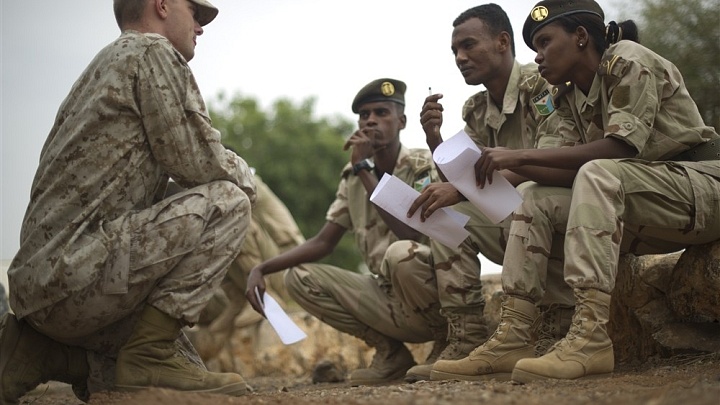
But now, as during the Cold War, security risks are perceived everywhere, and take precedence over rights, democratization, and development. AFRICOM’s principal criterion for collaboration with African militaries seems very simply those countries leaders’—elected and responsible, authoritarian and deeply corrupt, blood-soaked or otherwise—commitment to U.S.-defined “anti-terrorism.” Just this summer, AFRICOM has offered advice on military gender mainstreaming and conducted multinational Operation Southern Accord in Malawi and Operation Western Accord in Senegal, where US troops in June joined training in dealing with a “Mock Food Riot”. And the same month, a team of 15 sailors and marines visited oil-rich Gabon—where the billionaire Bongos, the late father and now his son, have ruled repressively for over forty years—to train local forces in skills including “detainee handling.” The State Department’s Bureau of African Affairs leads the separate—and presumably well coordinated—Partnership For Regional East Africa Counterterrorism (PREACT) and Trans-Sahara Counterterrorism Partnership (TSCTP).

Buttressing authoritarian regimes and/or armies that abuse their own peoples might provide short-term military successes, if any, and carry considerable downside risk. As likely is the delegitimization of governmental and societal authority that can incubate a “legitimized” and perhaps extreme resistance, and one that could conflate from local regimes to blowback against their backers.

Enlightened Counterterrorism?

There is no dearth of American efforts to promote the growth of democratic institutions in Africa. The ongoing tension between this long-term goal and the immediacy of perceived security threats often makes for deep contradictions in U.S. policy toward the continent. A recent U.S. State Department-commissioned report on West Africa notes that military aid “presently constitutes the bulk of U.S. Government assistance, far outweighing the extremely modest development and democratization assistance programs.” The report urges Washington to promote what it calls “enlightened counter-terrorism,” adding, “While it is clear that overarching U.S. Government regional security and counterterrorism interests will likely take precedence… counterterrorism efforts would likely be enhanced by a successful effort to address issues of political exclusion and marginalization, [and] a failure to address these issues would serve to undermine regime stability over the longer term.”

AFRICOM’s leaders, with their doctrine of “active security,” seem keenly aware that the need to “work in unison across agencies” and “respect human rights and the rule of law” are crucial to preventing conflict. Indeed, as U.S. Africa Special Operations Commander Brig Linder has noted, somewhat inarticulately, an important part of resolving insurgencies is convincing fighters and their supporters that “Life doesn’t have to suck.” AFRICOM Deputy Commander Lt. Gen. Steven Hummer repackaged a Mao aphorism: “I equate the violent extremist organizations to the crocodiles closest to the boat. You have to shoot them when they come up to the boat, so when the violent extremists impact or threaten U.S. interests, that’s what has to occur. But the bigger picture and strategic effort really needs to be draining the swamp.”

But the “war on terror” lens that places “U.S. interests” first and foremost can be as distorting as was that of anti-communism. If one paddles into the swamp, finding crocodiles should be no surprise. As Princeton Lyman writes, “The vast majority of conflict and ‘terrorist’ activity in Africa is not linked to international sponsorship or any vast conspiracy against the West.”

AFRICOM’s remit is indeed expansive. Yet it should be reason more for concern than praise that, “The tactics of special warfare can look quite a lot like those used by the Peace Corps,” as the New York Times recently noted. This simply should not be the military’s role. A core reliance on militarized solutions and the emphasis on military capacity building is too often at the expense of and perhaps to the detriment and demise of civil institutions, as occurred notably in Mali in 2013. The premise and many tactics of the global war on terror should by now have been thoroughly discredited.

Absent great care, AFRICOM might midwife newly capable and unaccountable generations of Praetorian Guards in countries across Africa. This would undoubtedly be bad for Africa’s peoples. And bad for business, too.

[All photos courtesy of AFRICOM.]


Thomas R. Lansner is visiting professor at the Paris School of International Affairs of Sciences-Po Paris, and taught on international media and communications at Columbia University from 1994-2011. From 1980-1990, he covered numerous conflicts, mostly in Africa and Asia, for the London Observer, the Guardian, and other media outlets.

FacebookTwitterGoogle+Print
Tags:
About the Author

Thomas R. Lansner is visiting professor at the Paris School of International Affairs of Sciences-Po Paris, and taught on international media and communications at Columbia University from 1994-2011. From 1980-1990, he covered numerous conflicts, mostly in Africa and Asia, for the London Observer, the Guardian, and other media outlets.

One Comment

  1. Eric A. Jorgensen / August 8, 2014 at 8:35 pm /Reply

    It’s like walking a tightrope, but if American military advisors had stayed there to help resist ISIS, the answer to a similar article about Iraq would likely have been, “Yes, we’re all safer.”

Leave a Reply